Thursday, November 11, 2010

I'm A Terrible Photographer

     That statement may come as a shock to you…. But it’s true.  You also might think that 16 years of photographing working cowboys would enhance, or at least mildly improve, my working knowledge and ability with the lens.  But it just ain’t so.
     All of the self-analyzation that I demand from artists in regards to their painting becomes relevant to me when I evaluate my skill behind the camera.  I haven’t lied to myself or tried to delude the little voice in my head that says I pretty much do a face plant when it comes to gathering good photos.
     As a matter of fact, I try and proclaim it as a weakness right up front.  You know --- reduce expectations and such, that sort of thing!  I liken it to this scenario: If you can’t dance, it’s better to announce it early and move on, than play it smug and end up as humiliation fodder at the end of the night.
     So we’ve established the weakness---now what?  Three words; three simple words will make you an artistic force to be reckoned with.  Three words will allow you to completely fool everyone…they will think you are a photographic genius!  The three words?  Shoot A Lot!  This is the secret weapon of yours truly, the inept photographer, Mark Kohler.
     There are those who know bracketing, F-Stops, apertures, and this and that.  But what saves me time and again is my personal motto:  Shoot A Lot!
     When I’m at a branding or gathering, I have several hard and fast rules that help to continually save face.  They just might work for you:
     #1:   Ask the cow boss, or whoever is in charge, where you can or can’t be.  This is nothing but courtesy and respect, and it just might get you invited back.
      #2:   Find a corner and try to disappear.  The photographer/artist who isn’t in the way…you guessed it….just might get invited back.
     #3:  Shoot a lot!  I sometimes shoot several thousand pictures at one event or branding.  This means I stumble, quite by accident, into some very nice photographs.  Back in the film days, it cost me a pretty penny, but with the digital camera, I throw the dogs out and keep the happy accidents.
     So there you have it; full disclosure.  I am a terrible photographer, but what I lack in talent, I make up for in persistence and volume.

All content and images © Mark Kohler Studio.

Wednesday, November 10, 2010

Moving Beyond Traditional

     I generally consider myself a traditional watercolorist.  Most of the time I paint light to dark and work through a specific spectrum of colors to arrive at a finished painting.
     The operative word in the preceding sentence is most. Moving beyond a “traditional watercolorist” is sometimes necessary to achieve the image that is in my head.
     Here are a few items that I would like to introduce you to.  You might find that they add very little to your method or approach, but give them a try and see if they don’t enhance some aspect of your work.

     Gum Arabic – I prefer the Winsor and Newton brand.  The label says it increases brilliancy, gloss and transparency; it controls the spread of wet-on-wet washes.  For the most part that is true.  Gum Arabic is a binder.  I add it to watery paint to give it more consistency.  It works great to add bits of dry brushing to the final (and upper) paint layers.  Go easy with Gum Arabic and do lots of testing.  But it can become a real asset in some paint applications.

     Ox Gall – Ox Gall comes from the bile duct of domestic cows and sounds like nothing I want near my watercolor paper after spending 4 to 6 hours getting my drawing down.  However, Ox Gall increases the flow and fluidity of your paint.  Big broad washes on rough paper are almost a necessity for an even wash.  Again, don’t get carried away.  Those early, big, broad washes that establish a tone or that serve as a block-in, can benefit from an Ox Gall application to your paint.  I try to avoid the more sedimentary colors and French Ultramarine Blue and Ox Gall don’t get along well.  So I try to use Cobalt Blue instead.  Consider its’ use and again, do some testing so you’re familiar with its’ properties.

     Gouache – The “chalk and cheese”, traditional British watercolorists frown on mixing traditional transparent watercolor and Gouache.  I leave the traditional crowd behind and do my own thing when it comes to mixing and matching these two.
     About 1/3 of my paintings are a mixture of these two mediums.  I’ve had good luck by establishing a broad traditional wash, and then as I layer up through my painting, I switch to Gouache to bump the intensity of the paint application.  Gouache is standard watercolor paint with white paint added.  I find an all Gouache painting to be chalky and powdery, and I just don’t like the final product.  However, underpaintings of watercolor and minimal Gouache applications can make your painting sing.

Desert Tarpon
     “Desert Tarpon” is a small painting that demonstrates what is possible with this technique.  It’s not loose and splashy like traditional watercolor.  In fact, it can become tedious and technical (I have to watch myself to keep from becoming too tight and detailed), but done right, it lends itself to some incredibly beautiful paint effects, which translate beyond watercolor’s perceived limits.
     If you’re just starting to paint, get a good grasp of your palette and paper choices.  When you’ve become comfortable and competent, give these three additives a try.


All content and images © Mark Kohler Studio.

Tuesday, November 9, 2010

Want To Paint Better? Become A Draftsman


     Webster defines it this way:  Draftsman:  2b. An artist skilled in drawing.  Sums it up rather nicely, don’t you think?  But we all know there is a lot of wiggle room there.
     This becomes very apparent when I teach workshops.  Everyone searches for the magic bullet that will allow him or her to paint better, and then somehow be able to leapfrog to good drawing skills.  In my opinion, they are one and the same.  There is no difference between the two.
     Calderon states it succinctly and abruptly …. “What is meant by Drawing?”  Many people are under the impression that it only refers to the elementary part of an artist’s education.  They do not realize that it is the very essence of all pictorial art, and that without it painting would be meaningless.
     It may seem like a rather strong statement, but everyone from Calderon to Watrous, and from Fechin to Watteau, can’t emphasize this enough.
     If you wish to make good paintings, sink your time, energy and hard work into achieving good drawings.  This post is about the big picture, literally.
     To be a competent artist, we must embrace this larger idea.  Many approaches exist in becoming a skilled draftsman.  David Leffel and Sherrie McGraw start from a gesture to establish a framework and build to a finished drawing.  The ateliers measure with straight lines and establish a block in measuring and slowly building their image along the way.
      Still others like Michael Workman employ a grid to establish a foundation for the early drawing.  Harley Brown measures with units (usually the size of the head) to start his initial work.
     The point is this:  there is more than one way to skin the proverbial feline.  But there is only one way to be a great painter.  I implore you today.  Declare yourself a draftsman, find the drawing style that works best for you and get busy.


Drawing Resources
The Language of Drawing – Sherrie McGraw
The Craft of Old Master Drawings – James Watrous
Bridgman’s Life Drawing – George Bridgman
Figure Drawing – Anthony Ryder

Content © Mark Kohler Studio.

Monday, November 8, 2010

Curious and Shy


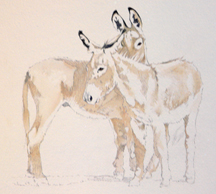
     So, on Friday we established a plan for my painting titled  “Curious and Shy”.  Today, we execute the painting, and with any luck, we will have a nice monochromatic watercolor that meets our composition and design, as well as doing justice to our chosen subject.
      I began my painting by first establishing some darks.  My first paint application was a dark grey in the eyes, nostrils and ears.  These darks establish enough early drawing for me to feel comfortable with proceeding.  As I’ve stated before, if I can’t peg the eyes then the painting has no soul and I usually don’t proceed any further.  I also start adding a basic wash to establish the burro’s form.  This wash consists of mixtures and layers of Raw Umber, Burnt Sienna, Burnt Umber and any blue (Cobalt or Ultramarine).  I used both.  This is the painting after these two paint applications.


     Next, I establish more darks (Ultramarine Blue and Burnt Umber) in the burro’s tails and the cross markings on their backs.  Also note that I put an atmospheric wash around their feet.  This helps to anchor my subject and incorporate them into the picture.  I’m sticking with my original idea and game plan.


     My next washes are a weak background wash of Ultramarine Blue on the right side.  This wash is the beginning of the execution of my original sketch.  I will layer several warm and cool glazes in this area to build up a nice textural and atmospheric effect.  I also establish the cast shadow on the ground.  This shadow really anchors my subject and moves my burros beyond being a vignette.  The background, like my limited palette, will be minimal, but effective.
      Here is the painting after the third paint application.


     My final paint application is the cast shadows on the burros, and more glazes on the background.
     For the cast shadows I use my purple shadow mix (Ultramarine Blue and Alizarin Crimson) and establish the darkest shadows.  The photo of my burros pushes this shadow to nearly black.  I stay at a value of about 8 and make a single pass with this color.  I don’t want this wash to be broken up or variegated.  Several weaker washes of Burnt Sienna and Ultramarine Blue in the background and I call the small painting finished and a success.
     Here is the final painting with its story that I presented to my collectors for my Painting Of The Week series.

Curious and Shy
The title of this painting turned out to be
the impetus to complete the painting.  These
two siblings are at opposite ends of the spectrum
when it comes to confronting the unknown.
The burro in the foreground is the inquisitive,
nosy type, while his brother, peering through the
safety of ears and mane, plays it on the safer side.
They continue to run wild in the high desert country
near Paulden, AZ.  I admit to a soft spot for their kind
and always look forward to any opportunity to
 portray their distinctive personalities. 

     If you would like to receive my weekly paintings for purchase, please email me at jmkohler@markkohlerstudio.com. 

All content and images © Mark Kohler Studio. 

Saturday, November 6, 2010

I Can Change My Own Damn Tire!

     Hopefully, you have all had the opportunity to view my latest YouTube video of my trip to Nevada.  In the video there is a captivating sequence where two cowgirls are fighting a rowdy calf, which just about gets the best of them.  I decided to do a painting of one of these cowgirls and tell you a bit of her story.  I hope you enjoy it!

I Can Change My Own Damn Tire!
     Georgia Black and her husband, Jay, ranch near Battle Mountain, Nevada.  For the smaller outfits, branding and gathering without the help of dayworkers requires the help of neighboring ranches.  This friendly reciprocity keeps the smaller outfits efficient and able to make ends meet.
     If you saw my video, you will recognize Georgia as a darn handy neighbor.  She very quietly went about the work of the day, pulling more than her share of the weight.
     I coaxed her from behind her sunglasses and captured many good shots of her working before the irons were pulled to cool, and the cattle were pushed out into the desert.
     As we loaded horses to call it a day, Georgia noticed a tire on her trailer was flat.  After a short call to her husband, Georgia set her jaw, and with a few curt words, she proceeded to locate the block lift and a star iron and go to the task at hand.
  Ranch women are a different breed, and in today's world, it sure is nice to see a woman get the job done.  I hope you find Georgia a breath of fresh air.

Have a good weekend and I'll see you back here on Monday!

Image and content © Mark Kohler Studio.


Friday, November 5, 2010

How To Use A Thumbnail


      I found myself sketching out thumbnails for a small little burro painting.  I have relied on working thumbnails since I was an illustrator.  A thumbnail is nothing more than thinking out loud in sketch form.
     A thumbnail lets you see a specific artistic decision prior to applying it to your actual painting.   And a thumbnail can help you make a design or composition decision, a tonal decision or a color choice.
     My little burro painting will be a very monochromatic painting with a rather limited palette.  I picked the photo because of an interesting title for the painting that popped into my head.  The ears on the burro in the foreground indicate a natural curiosity, while the burro in the background remains cautious, peering from behind his sibling.
     My title is “Curious and Shy”.  My focal point is the interplay of the burros’ heads.  The overlap makes for an interesting composition on its’ own, so I’m going with it.
     My next choice is how to handle the lost edges where the burros’ rumps are defined by my background wash.  I try several versions of background possibilities and settle on version #3.

     I want the wash on the right to define the outline of my foreground burro, while my other burro will be more an actual lost edge.  So here’s my game plan.  I will start the painting today and show you the final result next week.  Stay tuned.  

All content and images © Mark Kohler Studio.

Thursday, November 4, 2010

Pull Together

     I thought you might find it interesting to get another perspective on what it’s like to be on the inside of an artist’s life and career.  So I’ve asked my wife, Pam, to write a guest post from her vantage point.  I think it will give you food for thought.

     Thanks for tuning in today to hear what I have to say.  When Mark asked me to write this blog post, my first thought was “What could I offer the readers that would contribute to their art career?”
     So forgive me if I can’t address the intricacies of painting a shadow, or give you advice on improving your drawing skills.  But if you are the spouse or partner of an artist, I do believe I can offer some counsel on supporting the creative process.
     First of all, everything I have to say is merely my opinion, and may not apply to you.  But since Mark and I did not originally envision that our life together would include an art career, I’ve learned a few things during this journey that qualify as experience and they’ve worked for us.
     When Mark came to me 16 years ago and said he was unhappy in his work and wanted to pursue art as a profession full-time, I have to admit that it scared me to death.  But I didn’t hesitate to give my approval.  I knew his talent was a gift, and I had watched him struggle to fit his right-brained creativity into a left-brained and structured business world.  I didn’t want him to be 70 years old and say, “I wish I would have tried….”, so we agreed to give it a shot.
     The fear of going from two guaranteed paychecks to one was ever-present, but I knew if Mark was ever to succeed in the art business, we had to pull together as a team.
     And I believe this is one of the most important factors in the success of any artist.  For us, I think it helped that pulling together was something we valued in our marriage from the start.  And I have witnessed other artists’ careers suffer because their spouse isn’t involved in helping them to realize their dream and to follow their passion.
     I’ve had friends who thought I was subjugating my desires and needs in order to let Mark fulfill his.  But I guess I don’t view Mark Kohler Studio as “his” business, but “our” business.  We each have a role in its success.  And Mark is quick to give me credit for my contribution and to encourage my own creative writing skills.  So the best advice I can give an artist’s spouse is to check your ego at the door.
     The successful “artist marriages” work because the spouse is usually detail-oriented, and can “take care of business”, which allows the artist to concentrate on his craft and frees him up to produce.
      Within just a few years of starting his career, it became clear that Mark couldn’t concentrate on painting and producing AND handling all the details of a growing business.  So it was time for me to “go all in” and give up my full-time job, take over the day-to-day management, which would allow him to advance to the next level of his career.
     If I’m being honest here, the man can portray a horse’s soul in the reflection of its eye, but he can’t balance a checkbook!  And responding to all the emails, inquiries and applications would take forever with his one-finger typing method.
     So our roles are pretty well defined.  He paints and frames and I do everything else:  website design and maintenance, advertising and marketing, order framing supplies, make travel arrangements, book-keeping, prepare tax returns, and handle the mountains of paperwork that are involved in keeping up with show schedules, applications, UPS shipments of paintings, and consignments to galleries.
     It is a full-time job; six days a week, 10+ hour days.  But it is so rewarding!  We love our independent lifestyle and being our own boss (and if I’m going to continue being honest, neither of us were very good at working for other people).
     So if you are someone who likes to be part of a team, are detail-oriented, and likes the challenge of working together to achieve a goal, then take that leap of faith and go for it!
     Not only will you sharpen what skills you possess, but also you will discover new ones, along with a profound appreciation of what you can accomplish together.

P. S.  I was writing this piece the same time that Mark wrote his post yesterday, and it surprised me that we expressed some of the same thoughts.  Being on the same wavelength is what makes our team work!  

All content © Mark Kohler Studio.