Friday, November 19, 2010

Being An Artist Is A Lifestyle Choice


     I’ve touched on this in previous posts, and I’ve been considering and pondering the bigger picture.  What is my motivation to being an artist?  It’s a question you should ask yourself.  And I don’t mean for two minutes at the end of this post.  Really think about this question. Say it out loud and look at yourself in the mirror.
     My answer always comes back to two distinct, but affirmative statements:  1) “Because I see myself as an artist”, and 2) “Because I choose to live away from the city.”
     Let’s break these two down into the whys and wherefores, shall we?  #1:  I see myself as an artist and artisan.  In many ways the influence of my grandfather set me upon this path.  I like walking in the footsteps of a master craftsman that I’m connected to.  I feel as though I’m seeking my own destiny; the path that God created me for.
     #2:   Living away from the city --- this is a concept that people immediately understand, or they stare at me in bewilderment, with a cartoon question mark over their heads.  It’s rather difficult to explain, but let me try.
     I believe art allows me a lifestyle that I enjoy.  I’ve had the house with two cars in the driveway, and the job with a great income, benefits and profit sharing…. And I was miserable.  It sounds good on paper, but I was missing “life”. 
     Art allows me to live my life on my terms.  It can be a struggle, but so can Austin traffic.  I can’t see myself working a crappy job for big money to be able to afford the place in the country sometime in the future.  Why not make a little less and skip the benefits, but live a real lifestyle now?
     In the argument I have within my own head, I run all the rabbits, and it always results in the same conclusion:  “Art in the country.”  I have the hardest time understanding why I would want to spend a lifetime working for the opportunity to retire to a lifestyle.  Why not grab it now?  Art will let you.
     I realize this may not be your cup of tea.  You may have grown up in the country and waited your whole life to make the jump to a loft studio in the city.  You may have worked the corporate grind for the last thirty years and need a slower pace.  We’re all different, with different expectations and dreams, but I beg you to nail this one down.
     Once you identify your motivation to create your art, you will be unstoppable.  

All content © Mark Kohler Studio.

Thursday, November 18, 2010

The Ugly Underbelly Called Framing


      I’ve spent the better part of two days cutting moulding and gluing joints to make frames for 26 new works---all due by Thanksgiving!
     This is where the glamour ends and the grueling, knuckle-grinding work begins.  So this situation begs the question that artists must ask themselves…. How will I handle the framing of my work?
     The avenues are many, but when you break it all out there’s a big fat fork in the road that requires a decision.  Will I frame my own work?  Or, will I pay a professional framer?  One decision requires an investment in equipment and supplies, while the other requires more cash outlay to a professional.  Self-framers can execute their vision and meet their quality standards without the middleman.  However, sending out your framing gives you more time to produce.
     I like being in charge of my framing, but I don’t enjoy the process.  Framing is hard work and I don’t slight the professional for his time and profit.
     The reality of your circumstances will be the true barometer of your decision.  If you’re working out of an apartment with two bedrooms, a frame shop isn’t a reality, so start looking for a pro.  In my case, I live two hours from a major city and the remoteness dictates that I am better off building my own frames.  UPS delivers everything to my frame shop, and I figure the framing time into my final deadlines. 
     I have a separate space that is dedicated to framing, and I have a system for framing that has been developed over many years.  This process has been a consistent plus for our business. 
     I think next week I will frame one painting as a demonstration, from beginning to end.  This way you can see the underbelly of the framing beast and make an informed decision.  

All content and images © Mark Kohler Studio.

Wednesday, November 17, 2010

Lost Edges and Thumbnails


     Last week Maria said she was a bit confused about my comment on “lost edges”, so I will attempt to explain further.  Perhaps the subject of lost edges falls into the “composition” category.  We talk about it but we never really pin down how to do it.
     The problem is, both composition and edges can be subjective and exaggerated by the artist.  This makes them a mystery to some.
     The first thing we must address is that every time you draw or paint, whether you know it or not, you are dealing with, and creating edges.   You may not be planning or embellishing your edges, but they are there.  Edges can be created by line, color (purple meets red), or shadow (in this case, light meets dark).
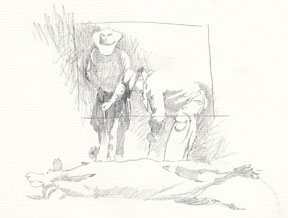
     For the sake of this discussion let’s simplify even more.  Today, we use our thumbnail we discussed last week and make some basic composition and edge decisions.  Here’s the photo we will start with.  Remember, my friend Walter?  Here he is helping us again.

     Today we will hold our edge discussion to “light lost edges” and “dark lost edges”.  If you get this part down, you will be on your way to becoming an edge expert.
     A light lost edge occurs when a light valued part of our subject fades into a light part of our painting.   It can be background, or something else, but when this happens our edge becomes lost….simple.
     Consequently, the reverse is also true.  A dark lost edge occurs when something dark in our subject merges into something dark in our painting, like a dark area of the background.

     I’ve decided to theoretically paint our cowboy photo.  Let’s start with our working thumbnail.  Compositionally, I make some big changes.  I scrap the cowboy to the far left completely.  Since I want to focus on Walter and the other young cowboy (named Chance).   I also decide to 86 the cowherd in the background.
     I’ve also drawn a square around the area that, for me, is the center of interest.  I will make this area the focal point of my painting.  Now it’s time to make some decisions on edges.

     To make my two subjects more interesting, I start playing with some nondescript shading in the background.  I realize right away that Walter’s back should be a lost edge (white into white).  Chance’s hat also has some lost edges on the highlight, or right side.  Also the rear leg of the cow can fade into the background.
     Walter’s hat fades into Chance’s belt line from the cast shadows.  This is a lost dark edge.  I decide to use the background tone to enhance my focal area.
     I also decide my background wash must define Chance’s right leg.  This time the lost edge is working against me.  But by adding a background tone, his leg reads correctly.
     In the final painting, this would be atmospheric washes, made to make my subject pop out from the page, or recede, depending on my artistic decision.
     Edges are a mystery until you start looking for them in your drawings and paintings.  We will continue to touch on them in our discussions.  If you would like to see this painting done as a demo, let me know.
     Maria, I hope this has cleared up some of your confusion.  And thanks for asking!  

Tuesday, November 16, 2010

Mastering The Trail


Everything about my friend Trina Campbell is colorful.  She’s a refreshing breath of intense, bright, right-in-your-face fresh air.
     Trina is the wife of noted horse trainer, clinician and all-around good guy Peter Campbell.  They run a 1400-acre horse operation near Wheatland, Wyoming.
Trina Campbell

     Trina has been in my neck of the woods these past few days, giving her own instruction and insight to a good bunch of folks near Cuero, Texas.  She has been a favorite subject of mine since we met many years ago.  But I must admit that it’s damn near impossible to adequately illustrate through paint, all that is Trina.
     A larger than life character, Trina is drawn to people who have focus and drive.  Her intensity for horsemanship is evident in flashes of brilliance, and she is able to lighten the mood and keep those around her moving forward.
     After spending the better part of two evenings with Trina and friends, I’ve come to see a genuine, honest and caring person.  But make no mistake---Trina has little time for suffering fools, and those who refuse to dedicate themselves to the basics and foundations of their craft, will be summarily dismissed.
Peter Campbell
     This philosophy is common ground between us.  Trina, like myself, is drawn to individuals who pride themselves on fine craftsmanship.  Our mutual friend John Weinkauf is the perfect example.  Considered by many to be the finest handmade boot maker in the country, John represents Trina’s philosophy to the highest degree.  The level of skill and craftsmanship exhibited by masters such as Peter, Trina and John will generally be lost on the masses (even those who consider themselves self-appointed connoisseurs of finer things).
     Please don’t take my words wrong here.  There are many fine craftsmen of gear and art to be had.  But the level of work and expertise that skilled artisans like John Weinkauf or Silversmith Mark Drain exhibit are at a remarkable level.  They are true master craftsmen rooted in the knowledge of basics and foundation.
     So hats off to Trina Campbell for once again showing me that “Mastery of Craft”, be it Peter Campbell with his horse and light hand, or John Weinkauf with last and thread is a trail of choice; a trail the artist or artisan must choose to walk.  It’s a trail where mastery and quality is dictated by only one ….. that’s you! 

All content © Mark Kohler Studio. 
       

Monday, November 15, 2010

Dream Killers


     It’s my opinion that there are two types of Dream Killers: those that exist in the world around us, and those that live inside our head.  Of the two, I have no doubt that the type we allow to dictate our action from inside our own thinking is the most dangerous.  More on that in a second. 
     The Dream Killers that exist around us are everywhere.  They can be our parents, telling us in no uncertain terms, “You can’t make a living as an artist”, or “I wanted you to be a lawyer.”  It can be the talking head on CNBC telling us “the economy is in an irreversible tailspin.”  Maybe it’s our best friend who is working a subtle sabotage because you might be succeeding in a life-long goal that makes Best Friend feel a bit inadequate.  If could be a spouse who has two feet anchored on the security side of the fence, and can’t chance allowing you to pursue your real passion. 
     I could list 20 more people with seemingly good reasons you shouldn’t take one step down that artistic path.  They exist everywhere and are well-versed in arguments on why you can’t.
     But they can do little harm until we allow their opinions to cross over from an outside influence to one that gets in our heads.  This is where dreams die fast.  You are the gatekeeper and whatever outside force you let influence your thinking, now becomes your responsibility. 
     Generally speaking, 99% of the people you know (friends and family) don’t care if you want to be an artist.  They haven’t even pondered this thought one time.  You see, Dream Killers only make their opinions known once you commit to something as grand as pursuing your passion.   Recognize their opinions for what they really are….a worry, a loss of some sense of real security, fear for you, fear for themselves.  Whatever it is, it doesn’t matter!  It’s your passion.  Grab it while you can!  And keep the Dream Killers out of your own head.
     Did you know that less than 1/10th of 1% of the population could do what you can already do?  You’ve been given a gift.  Now you must decide.
     Press forward and work on your skills, technique, and craft; get better, try harder.  Or listen to the Dream Killers and park your butt on the easy and safe road.
     Do you remember William Wallace of “Braveheart” telling his men before the battle of Sterling, “What will you do without freedom?”  A warrior answers him, “We will run, and we will live.”  Wallace challenges their response:  “Aye, you will live.  And dying in your beds many years from now, would you be willing to trade all the days from this day to that, for just one chance?”  Will you?

All content © Mark Kohler Studio.


Saturday, November 13, 2010

We Get Along

     This weekend's post features one of the images from a new book that I have published with Kathy McCraine, called Cow Country Cooking:  Recipes and Tales from Historic Ranches of Northern Arizona.
Not only does the cookbook give you delicious recipes, but you get wonderful insight into the iconic lifestlye of the cowboy.   You'll see why their passion fits so nicely with mine.
     I hope you enjoy the post, have a good weekend, and I'll see you back here on Monday.


We Get Along
I constantly find myself trying to reconcile the cowboy lifestyle in my own head.  It’s sometimes difficult to weigh the upside of freedom to the downside of bad weather, strong-willed horses, hard country and the whims of cattle---not to mention the short pay.  But free men are generally contented men, and cowboys seem to find satisfaction in the mundane little victories of life.  These include good horses, quality gear and country that’s pleasing to the eye.  When you break it all down, the freedom to pursue our passion is all we really need.  The only difference between most of us and the cowboy, is that he has found his.

Friday, November 12, 2010

Where's My Style?


The more you paint, the better your technical ability becomes.  More time painting, means better familiarity with your palette, a more succinct and confident drawing hand, and the closer you move to developing a style….a style that’s you.
     As artists, (myself included) we are guilty of envisioning a style and then working from back to front to develop it.  It’s a natural tendency to see something that moves us and then move in that direction.  My personal opinion is that we have a lot of cart, and no horse in sight.  The apprentice/traditional method is just the opposite of this method and the direction I would have you travel.
     This way of thinking targets the bigger picture.  What if we spent our time developing a super skill set, starting with good drawing, then moving into a limited painting palette, and finally embracing a full spectrum of painting skills?  With this war chest of knowledge and technical ability, we could then focus on style. 
     I freely admit that I backed down this same road at breakneck speed.  And I’ve had to take a circuitous route to find exactly what I want to say with my work, and how to say it.
     I’m not sure if this is a by-product of American teaching methods, our drive to be free to create unimpeded, or if we have just lost the knowledge of basics and foundations altogether.
     Please consider my, for lack of a better word, “theory”, and let this sit on the back burner for a while and percolate.  The discipline and hard work will be difficult and demanding.  Just remember this:  the road to find your style and artistic voice are tough.  And you alone are responsible for the artistic path you choose.  Choose one that gives you skills, and the road to developing your own personal style will be rewarding and a process that defines who you are as an artist.

All content © Mark Kohler Studio.